One platform for the
post-quantum era.
MyPQC is one layered stack. A Crypto Agility Core Engine sits at the foundation. On top of it run four quantum-safe apps and managed PKI and monitoring services. A single API layer opens the whole platform to the enterprise software providers and Tier-1 integrators who build on it. Post-quantum by default and national by design and agile enough to swap algorithms by policy.
Aligned with NIST FIPS 203 / 204 / 205 · national KAZ options alongside · W3C DID data model (v1.1) · Digital Signature Act 1997
The platform at a glance
Four layers with one national foundation
An API layer for builders and four turnkey quantum-safe apps for users and managed services for operators. All of it rests on the Crypto Agility Core Engine which governs which algorithm runs.
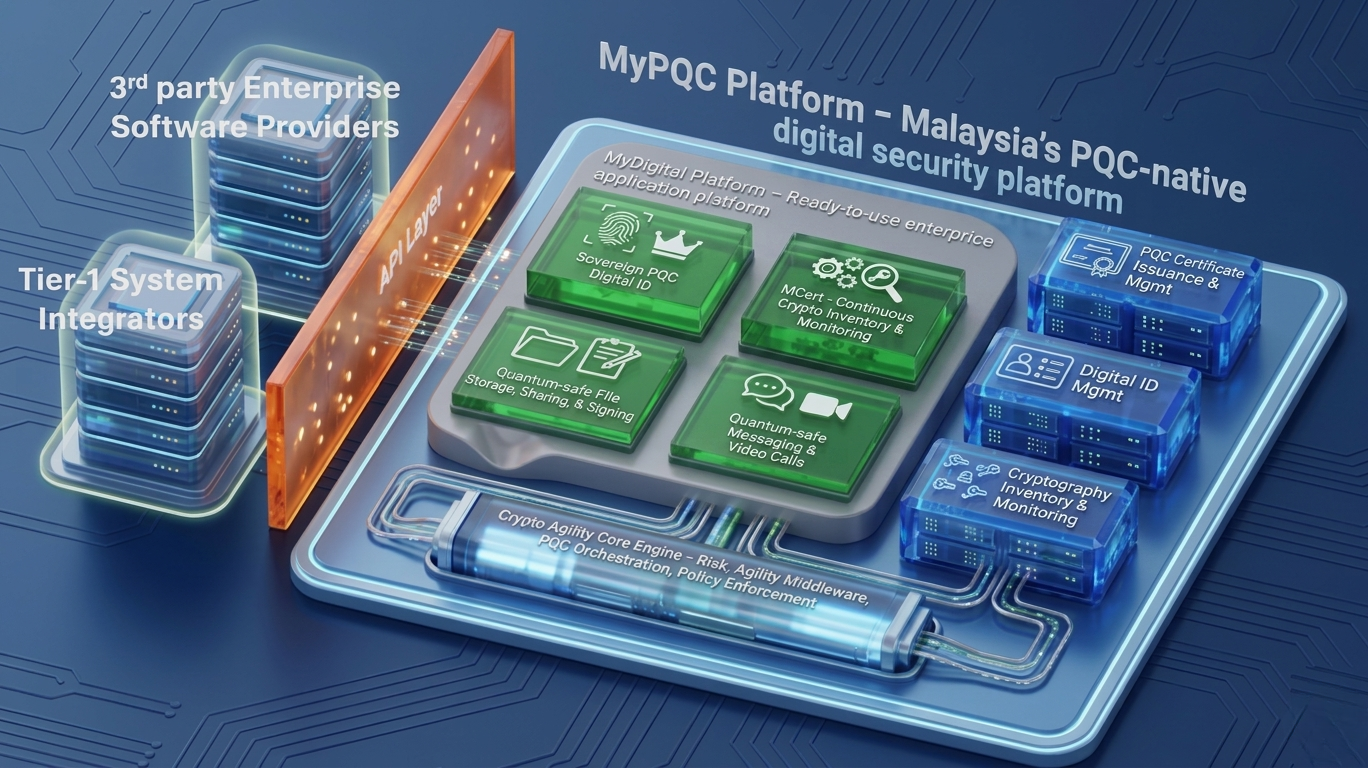
The MyPQC stack. The API layer surfaces the platform to integrators. The ready-to-use apps and managed services sit in the middle. The Crypto Agility Core Engine (risk · agility middleware · PQC orchestration · policy enforcement) is the foundation everything else builds on.
How the platform is layered
Every layer does one job. Cleanly.
The crypto-governance foundation stays separate from the apps that use it and the API that exposes it. Each layer can change without breaking the others.
Crypto Agility Core Engine: the foundation
The policy-driven layer beneath everything: crypto-risk assessment · agility middleware · PQC orchestration · enterprise-wide policy enforcement. A CISO changes the algorithm for a cryptographic purpose from one portal and every connected system applies it. No application code changes. No redeployment.
Ready-to-use apps
Quantum-safe applications built directly on the core engine: Sovereign PQC Digital ID · Document Signing · Secure File Sharing & Storage. Quantum-safe Messaging & Video is on the roadmap. Deploy the app suite instead of assembling crypto yourself.
Managed services
Operated capabilities that keep the estate healthy: PQC certificate issuance and management · digital-ID management · continuous cryptography inventory and monitoring. This is the observability and PKI plane that feeds the core engine what it needs to govern.
API layer
One versioned integration surface for third-party enterprise software providers and Tier-1 system integrators. Partners embed quantum-safe identity and signing and sharing and crypto-agility into their own products without building cryptography from scratch.
The four apps
Ready to use. Quantum-safe. Crypto-agile from day one.
Adopt the whole suite or start with a single app. Each one is PQC-native and inherits the same trust anchor and policy model and tamper-evident audit spine.
Sovereign PQC Digital ID
Self-sovereign identity adapted from the W3C DID data model with post-quantum keys and X.509 linkage for legally recognized signatures in Malaysia.
Learn moreMCert: Crypto Inventory
Continuously discover and inventory and monitor every cryptographic asset: CBOM/SBOM · quantum-risk scoring · signed regulator reporting.
Learn moreDocument Signing
Add a post-quantum signature to any file including PDFs. Anyone can verify it with no PQC software of their own.
Learn moreSecure File Sharing
End-to-end encrypted sharing with per-recipient PQC key wrapping · revocation · expiry · cryptographic shredding after delivery.
Learn moreQuantum-safe Messaging & Video
National post-quantum messaging and video on the same platform trust model and Crypto Agility Core Engine. On the roadmap.
Learn moreHow migration works
Discover → Govern → Prove
MyPQC turns post-quantum migration from a one-off project into a repeatable and auditable program. Visibility first. Policy-driven control next. Verifiable evidence last.
Discover
MCert's containerized ephemeral scanners run across servers and apps and network devices and containers and code. They find every algorithm and certificate and key and protocol and crypto library. Everything is normalized to CycloneDX CBOM/SBOM and scored for quantum risk. You can't migrate what you can't see.
Govern
The Crypto Agility Core Engine turns those findings into policy. Bind a cryptographic purpose to an algorithm. Schedule a transition with an effective date. Every connected system switches automatically with no redeploy. The self-describing envelope keeps everything already encrypted or signed verifiable.
Prove
Signed and optionally encrypted CBOM and risk reports plus a tamper-evident audit trail show exactly which algorithms are in use and how far migration has progressed. The next scan auto-verifies remediation against the live environment.
Measured against an industry standard
Quantum-safe means different things to different vendors. Here's a real scale.
The PKI Consortium built the PQC Maturity Model because terms like quantum-ready get used loosely across the industry. It gives buyers and vendors a structured six-level scale (0 to 5) to assess a product or service against instead of taking a marketing claim at face value.
-
Level 0: None
No post-quantum cryptography is implemented anywhere in the product.
-
Level 1: Initial
Post-quantum algorithms exist for testing only. Nothing is production-ready yet.
-
Level 2: Foundational
At least one quantum-safe algorithm is production-ready and meets the relevant standards.
-
Level 3: Advanced
A real cryptographic inventory exists (CBOM/SBOM) and the product supports crypto agility.
This is exactly what MCert's discovery and the Crypto Agility Core Engine build.
-
Level 4: Managed
Legacy algorithms are eliminated or isolated. Hybrid classical and post-quantum support is available.
Reached by continuing to run policy-driven algorithm changes through the agility engine.
-
Level 5: Optimized
Quantum-safe is the default. Performance is benchmarked and the implementation is independently verified.
The scale is cumulative. Reaching Level 3 means Levels 1 and 2 are already satisfied. MyPQC's Discover step is what a Level 3 inventory looks like in practice. The Govern step is what Level 3's crypto-agility requirement means day to day and it is also the mechanism that moves an estate toward Level 4 and Level 5 over time.
Source: PKI Consortium PQC Maturity Model . MyPQC is not a PQCMM assessor or certifying body. Formal assessment and certification are run through the PKI Consortium.
Why national & standards-based
Aligned with the NIST standards. National by choice.
MyPQC implements the finalized NIST post-quantum algorithms and offers Malaysian algorithms alongside them. Crypto-agility means the choice is never locked in. You standardize on open standards and keep the freedom to swap algorithms by policy as guidance evolves.
Aligned with NIST FIPS 203 / 204 / 205. MyPQC implements the finalized NIST PQC standards: ML-KEM · ML-DSA · SLH-DSA. (This is standards alignment and not a FIPS-140 validation claim.)
National KAZ options alongside. KAZ-SIGN and KAZ-KEM are optional and policy-selectable Malaysian algorithms offered alongside the NIST standards. They never replace them and they stay swappable at any time.
Digital Signature Act 1997 alignment. Identity and signing link to an X.509 certificate from an MCMC-licensed CA for legal recognition. This is a deployment capability. Not an automatic guarantee.
On a credible timeline. NIST's proposed roadmap (draft IR 8547) would deprecate RSA/ECC around 2030 and disallow them around 2035. "Harvest now and decrypt later" already puts today's encrypted data at risk.
Standards & algorithms
| Purpose | NIST standard | National option |
|---|---|---|
| Key encapsulation | ML-KEM · FIPS 203 | KAZ-KEM (optional) |
| Digital signatures | ML-DSA · FIPS 204 | KAZ-SIGN (optional) |
| Hash-based signatures | SLH-DSA · FIPS 205 | None |
| Symmetric encryption | AES-256-GCM | None |
| Crypto inventory | CycloneDX CBOM / SBOM | MySEAL / NACSA mapping |
Reporting maps to NIST SP 800-131A · MySEAL · NACSA · BNM RMiT with secure regulator transfer to NACSA and Bank Negara Malaysia. Identity is adapted from the W3C DID data model (a Candidate Recommendation at v1.1).
See the whole platform in action
Get a walkthrough of the layered stack and a quantum-readiness assessment for your organization.